Scale Conversion Calculator
Free scale calculator and scale converter for model, drawing and map scales: convert any measurement between 1:24, 1:48, 1:72, 1:100 or any custom ratio, in metric or imperial units. Enter the original length, its scale and the target scale to get the new size instantly. To work out a ratio from a model and a real measurement, use the scale factor calculator further down this page; for map distances, use the Map Scale Calculator.
On this page: Converter · Scale factor · How to use · Formulas · Examples · Scales · Tips · FAQ
Scale Calculator
Scale conversion tool
Scale Factor Calculator
The scale factor is the number that tells you how many times larger or smaller a model, drawing or map is than the real object. Enter any two of the three values below and the missing one is calculated instantly.
Result :
Divide the real length by the model length, after converting both to the same unit:
scale factor = real length ÷ model length
Example: a real car is 480 cm long and the model is 20 cm long. 480 ÷ 20 = 24, so the scale is 1:24.
How to Use the Scale Converter
This scale conversion calculator changes a length from one model or drawing scale to another. It is useful when plans, model parts, miniatures or dimensions are supplied at a different scale from the one required for your project.
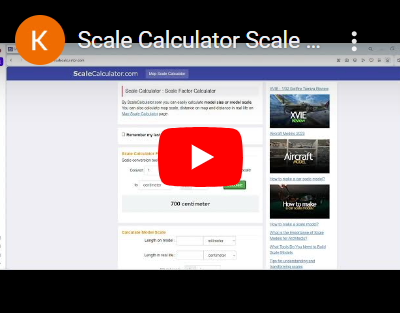
- Enter the measurement you want to convert.
- Select its unit and enter the original scale denominator. For 1:24, enter 24.
- Select the output unit and enter the target scale denominator.
- Press Calculate to get the converted model or drawing length.
The converter accepts millimetres, centimetres, metres, kilometres, inches, feet, miles and nautical miles. Input and output units can be different.
Scale Conversion Formula
The calculator first restores the real-world equivalent of the input measurement and then divides it by the target scale:
target length = input length × input scale ÷ target scale
When the input and output use different units, the length is converted to a common base unit before this formula is applied.
Calculate model or drawing size
model length = real length ÷ scale factor
Example: a 1:72 aircraft with a real wingspan of 3600 cm becomes 3600 ÷ 72 = 50 cm.
Calculate the real-life size
real length = model length × scale factor
Example: a 75 mm miniature at 1:32 represents a real height of 75 × 32 = 2400 mm, or 2.4 m.
Calculate the scale from two measurements
scale denominator = real length ÷ model length
If a 12 m room is shown as 24 cm on a floor plan, first convert 12 m to 1200 cm. Then 1200 ÷ 24 = 50, giving a drawing scale of 1:50.
Linear, area and volume scaling
These formulas work with linear dimensions such as length, width or height. Area and volume do not change by the same amount: area changes by the multiplier squared and volume by the multiplier cubed. For a 1:10 model, areas are at 1:100 and volumes at 1:1000 relative to the real object.
Scale Converter Examples
| Conversion | Calculation | Result |
|---|---|---|
| 12 cm from 1:24 to 1:48 | 12 × 24 ÷ 48 | 6 cm |
| 80 mm from 1:72 to 1:48 | 80 × 72 ÷ 48 | 120 mm |
| 5 in from 1:50 to 1:100 | 5 × 50 ÷ 100 | 2.5 in |
| 250 mm from 1:35 to 1:72 | 250 × 35 ÷ 72 | 121.53 mm |
A conversion to a scale with a larger denominator makes the model smaller: converting 1:24 to 1:48 halves every linear dimension. Converting in the opposite direction doubles each length.
Worked scale factor examples
| Problem | Calculation | Answer |
|---|---|---|
| 480 cm car, 20 cm model | 480 ÷ 20 | 1:24 scale |
| 36 m aircraft at 1:72 | 36 ÷ 72 | 0.5 m model |
| 150 mm model at 1:35 | 150 × 35 | 5250 mm real length |
| 1000 px image resized to 500 px | 500 ÷ 1000 | 0.5 resize factor |
Common Modelling Scales
| Scale | Scale factor | Typically used for |
|---|---|---|
| 1:12 | 12 | Dollhouses, large motorcycle kits |
| 1:18 | 18 | Collector die-cast cars |
| 1:24 / 1:25 | 24 / 25 | Car model kits |
| 1:32 | 32 | Aircraft, farm models |
| 1:35 | 35 | Military vehicles, armour |
| 1:48 | 48 | Aircraft (quarter inch scale) |
| 1:72 | 72 | Aircraft, most common kit scale |
| 1:87 (HO) | 87 | Model railways |
| 1:100 | 100 | Architectural models |
| 1:144 | 144 | Small aircraft, spacecraft |
Where Scale Calculations Are Used
- Model kits: convert aircraft, vehicle, ship and figure parts between modelling scales.
- Model railways: compare HO, N, O and other railway dimensions.
- Architecture: adapt dimensions between floor plans, elevations and presentation models.
- Miniatures: resize furniture, scenery and printable templates.
- Technical drawings: enlarge or reduce measured details while preserving proportion.
Tips for Accurate Scale Conversion
- Enter only the denominator: use 72 for a scale written as 1:72.
- Choose the unit that matches the measurement instead of converting it manually.
- Measure the same feature at both scales, such as overall length or wingspan.
- Keep extra decimal places for small parts and round only the final cutting dimension.
- Remember that this tool converts linear dimensions; area and volume change by squared and cubed ratios.
Common scale factor mistakes
- Mixing units: convert metres, centimetres, millimetres, inches or feet before dividing.
- Reversing the ratio: for a 1:n model scale, divide real length by model length.
- Using zero or negative values: physical lengths and scale denominators must be positive.
- Applying a linear factor to area or volume: square or cube the multiplier as appropriate.
- Rounding too early: keep several decimal places until the final measurement.
Scale Calculator Questions
How do I convert from 1:24 scale to 1:48 scale?
Multiply the original model length by 24 and divide by 48. The result is half the original length because a 1:48 model is half as large linearly as the same object at 1:24.
Can the scale converter use different units?
Yes. You can enter a value in inches and receive the result in millimetres, for example. Select the correct input and output units before calculating.
What is the difference between the scale converter and the scale factor calculator?
The converter at the top of this page changes a known measurement from one scale to another. The scale factor calculator finds the scale, the model size or the real size when any two of those three values are known. Both tools are on this page.
Does a scale factor have units?
No. A scale factor is a ratio and has no unit. The two lengths used to calculate it must, however, be expressed in the same unit before division.
What does a 1:100 scale mean?
It means one unit on the drawing or model represents 100 of the same units in real life. One centimetre on a 1:100 floor plan therefore represents one metre in reality.
Is a larger scale number a smaller model?
Yes, when comparing scales written as 1:n. A 1:100 model is smaller than a 1:50 model of the same object because each model unit represents more real-world units.
Can I calculate a scale factor with different units?
Yes. Select the correct unit for each length and the calculator converts them before calculating the ratio.
How do I draw a scale bar for a map or plan?
Use the Scale Bar Generator to build a graphic scale bar sized for your drawing scale, then download it as SVG or PNG.
How do I convert an architectural scale such as 1/4" = 1'-0"?
Imperial drawing scales convert to ratios: 1/4" = 1'-0" is 1:48 and 1/8" = 1'-0" is 1:96. The Architectural Scale Calculator accepts those scales directly and answers in feet and inches.
Can I measure a drawing without a ruler?
Yes. The on-screen Scale Ruler is calibrated against a bank card and reads real-world size at any drawing scale.
How do I find the scale of a floor plan that has none marked?
Measure a feature whose real size you know, such as a door, and divide the real length by the measured length. The Floor Plan Scale Calculator does this and snaps the answer to the nearest standard scale.
What percentage do I print a drawing at to change its scale?
Divide the current scale denominator by the one you want: 1:100 to 1:50 is 200 %. The Print Scale Calculator works this out and also checks what scale a sheet actually came out at.
How do I redraw a detail at a different scale?
The Drawing Scale Converter converts a drawn length between any two drawing scales, including imperial and enlargement scales such as 2:1.
From our blog
XVIE : 1/32 Spitfire Tamiya Review

Aircraft Models 2023

How to make a car scale model?

Your views and suggestions are important to us.
Click here to submit your suggestions.